The Rule of the Zhou Family Was Characterized by
The Zhou Dynasty (1046-256 BCE) was among the near culturally significant of the early on Chinese dynasties and the longest lasting of any in China's history, divided into two periods: Western Zhou (1046-771 BCE) and Eastern Zhou (771-256 BCE). It followed the Shang Dynasty (c. 1600-1046 BCE), and preceded the Qin Dynasty (221-206 BCE, pronounced "chin") which gave China its proper name.
Among the Shang concepts adult by the Zhou was the Mandate of Heaven – the conventionalities in the monarch and ruling firm as divinely appointed – which would inform Chinese politics for centuries subsequently and which the House of Zhou invoked to depose and replace the Shang.
The Western Zhou period saw the rise of decentralized state with a social hierarchy corresponding to European bullwork in which state was endemic by a noble, accolade-bound to the king who had granted it, and was worked by peasants. Western Zhou fell but earlier the era known as the Jump and Autumn Period (c. 772-476 BCE), named for the state chronicles of the time (the Bound and Autumn Annals) and notable for its advances in music, verse, and philosophy, especially the development of the Confucian, Taoist, Mohist, and Legalist schools of thought.
Eastern Zhou moved the capital to Luoyang and continued the Western Zhou model merely with an ever-increasing breakdown of the regal Chinese regime which resulted in the claim that the Zhou had lost the Mandate of Heaven. The weakness of the rex'due south position gave ascent to the chaotic era known every bit the Warring States Period (c. 481-221 BCE) during which the vii separate states of Mainland china fought each other for supremacy. This menstruum ended with the victory of the state of Qin over the others and the establishment of the Qin Dynasty which tried to erase the accomplishments of the Zhou in society to plant its own primacy.
The Zhou Dynasty made pregnant cultural contributions to education, literature, philosophical schools of thought, besides as political & religious innovations.
The Zhou Dynasty made significant cultural contributions to agronomics, education, military arrangement, Chinese literature, music, philosophical schools of thought, and social stratification also as political and religious innovations. The foundation for many of these developments had been laid past the Shang Dynasty but the grade in which they came to be recognized is entirely credited to the Zhou.
The civilization they established and maintained for almost 800 years enabled the development of the arts, metallurgy, and some of the most famous names in Chinese philosophy, amongst them Confucius, Mencius, Mo Ti, Lao-Tzu, and Sun-Tzu all of whom lived and wrote during the flow known as the fourth dimension of the Hundred Schools of Idea during which individual philosophers established their own schools. The contributions of the Zhou Dynasty provided the foundation for the development of Chinese civilization by those that followed, most notably the Han Dynasty (202 BCE-220 CE) which would fully recognize the value of the Zhou Dynasty'southward contributions.
Fall of the Shang & Rise of the Zhou
Prior to the Zhou was the Shang Dynasty who overthrew the Xia Dynasty (c. 2700-1600 BCE), claiming it had become tyrannical, and the Shang leader, Tang (dates unknown) and then stabilized the region and initiated policies encouraging economic and cultural advances. The Shang made the most of the fertile soil on the banks of the Yellow River to produce abundant harvests, providing more nutrient than required, the surplus of which then went toward trade. The resulting prosperity allowed for the development of cities, (some on a big calibration, such as Erligang), arts, and culture.
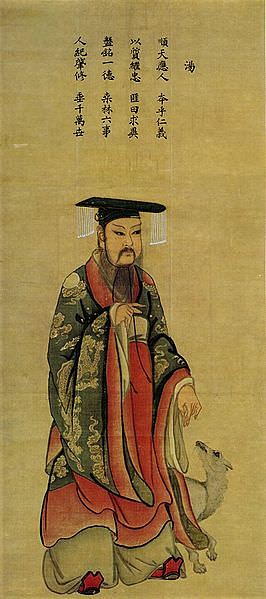
Male monarch Tang of Shang
The gods' blessing of a king was axiomatic in the prosperity of the land and the general well-being of the people. Any decline in either was interpreted as a sign the monarch had cleaved his contract with the gods and should be deposed. The last Shang emperor, Zhou (also given as Xin), became as tyrannical as the earlier Xia kings had been. He was challenged by King Wen of Zhou (l. 1152-1056 BCE) and was overthrown by Wen's second son, King Wu, who reigned 1046-1043 BCE as the kickoff king of the Zhou Dynasty.
Western Zhou
King Wu at commencement followed the paradigm of the Shang in establishing a central government on either side of the Feng River known as Fenghao. Wu died shortly later, and his brother, Dan, the Duke of Zhou (r. 1042-1035 BCE), took control of the government every bit regent for Wu's immature son, Cheng (r. 1042-1021 BCE). The Duke of Zhou is a legendary character in Chinese history as a poet-warrior and writer of the famous book of divination, the I-Ching. He expanded the territories east, and ruled respectfully, abdicating when the son of Wu came of age and took the throne as King Cheng of Zhou. Not every region under Zhou command admired their policies, notwithstanding, and rebellions throughout the vast realm broke out, inspired past factions wishing to dominion themselves.

Map of Western Zhou
A centralized government could non maintain the big territory that had been conquered and and then the ruling firm sent out trusted generals, family members, and other nobles to establish smaller states which would exist loyal to the king. The policy of fengjian ("establishment") was instituted which decentralized the regime and allotted land to nobles who acknowledged the supremacy of the Zhou king. The fengjian policy established a feudal organisation and social hierarchy which ran, elevation to bottom:
- Male monarch
- Nobles
- Gentries
- Merchants
- Laborers
- Peasants
Each noble formed his own separate land with its own legal arrangement, tax code, currency, and militia. They paid homage and taxes to the Zhou king and provided him with soldiers when necessary. In order to strengthen the king's position, the Mandate of Sky concept was more than fully adult. The king fabricated sacrifices at the upper-case letter on behalf of the people and the people honored him with their loyalty and service.
This was one of the few times in China'southward history that the upper & lower classes worked together for the greater common good.
The fengjian policy was so successful, producing such abundance of crops, that the resultant prosperity validated the Zhou every bit possessing the Mandate of Sky. The wealth that was generated encouraged the and so-called well-field system which divided lands between those cultivated for dignity and the king, and those worked by and for the peasantry. This was i of the few times in China'south history that the upper and lower classes worked together for the greater mutual proficient.
The Zhou civilisation, naturally, flourished with this kind of cooperation. Works in statuary became more sophisticated and the metallurgy of the Shang, overall, was improved upon. Chinese writing was codified and literature developed, as evidenced in the work known every bit Shijing (the Book of Songs, composed 11th-seventh centuries BCE), 1 of the Five Classics of Chinese literature. The poems of the Shijing would take been sung at court and were idea to encourage virtuous behavior and pity for members of all social classes.
This fourth dimension of prosperity and relative peace, however, could not concluding. Scholar Patricia Buckley Ebrey comments:
The decentralized rule of the Western Zhou had from the beginning carried within it the danger that the regional lords would go so powerful that they would no longer answer to the commands of the rex. As generations passed and ties of loyalty and kinship grew more distant, this indeed happened. In 771 BCE, the Zhou king was killed by an brotherhood [of tribesmen and vassals]. (38)
Western Zhou fell when invasions, most likely by the peoples known equally the Xirong (or Rong), farther destabilized the region. The dignity moved the uppercase to Luoyang in the east which gives the next period of Zhou history its name of Eastern Zhou.
Eastern Zhou
By all accounts, the era of Eastern Zhou was chaotic and violent but managed to produce literary, creative, and philosophical works of startling originality and substance. The Spring and Fall Period which begins the era of Eastern Zhou still retained some of the courtesy and decorum of the days of Western Zhou only that would not concluding for long. The separate states – Chu, Han, Qi, Qin, Wei, Yan, and Zhao - all had more ability than the Zhou at Luoyang at this time. All the same, it was even so idea that the Zhou held the Mandate of Sky and so each state tried to prove themselves the Zhou successor.
In the early on years of the Spring and Autumn Menstruation, knightly in battle was even so observed and all vii states used the same tactics resulting in a series of stalemates since, whenever one engaged with another in battle, neither could gain an reward. In time, this repetition of seemingly endless, and completely futile, warfare became simply the way of life for the people of Cathay during the era at present referred to as the Warring States Period. The famous piece of work The Art of War by Sun-Tzu (50. c. 500 BCE) was written during this fourth dimension, recording precepts and tactics 1 could apply to gain advantage over an opponent, win the war, and constitute peace.
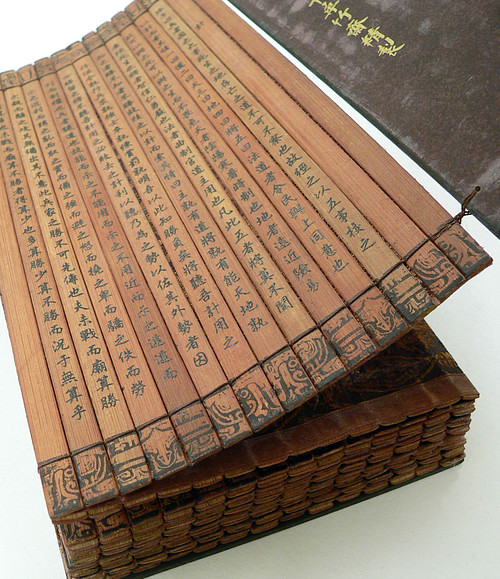
The Art of War by Sun-Tzu
How widely read The Art of State of war was at this time is unknown but Sun-Tzu was not the only one who tried to end the violence through stratagems. The pacifist philosopher Mo Ti (as well given equally Mot Tzu, l. 470-291 BCE) went to each country, offering his knowledge in strengthening a urban center's defenses as well equally offensive tactics in battle. His idea was to provide each state with exactly the aforementioned advantages, neutralizing all, in the hope that they would realize the futility of farther warfare and declare peace. His programme failed, notwithstanding, considering each state, like a die-hard gambler, believed that their next offensive would result in the large win.
A Qin statesman named Shang Yang (d. 338 BCE), following Sun-Tzu's lead, advocated for total war, without regard to the old laws of chivalry, and stressed the goal of victory past any means at one'due south disposal. Shang Yang'south philosophy was adopted by Rex Ying Zheng of Qin who embarked on a brutal entrada of carnage, defeated the other states, and established himself as Shi Huangdi, the first Chinese emperor. The Zhou Dynasty had fallen, and the Qin Dynasty now began its reign over People's republic of china.
Zhou Contributions
The Qin would undo many of the advances of the Zhou but could non completely rewrite history. In the same way the Zhou had drawn on the accomplishments of the Shang, so the Qin did with the Zhou. The Zhou's advances in agriculture, for example, were kept and improved upon, notably irrigation techniques, dam building, and hydraulics which would be instrumental in Shi Huangdi's construction of the Grand Canal.
The use of cavalry and chariots in Chinese warfare (also originally Shang developments) were farther adult by the Zhou and kept by the Qin. The Zhou had brought horsemanship to such a high level that it was considered a grade of art and a requisite for the education of princes. Horses were idea so of import, they were oft buried with their masters or sacrificed for the spiritual power and protection their energy could provide to the deceased.
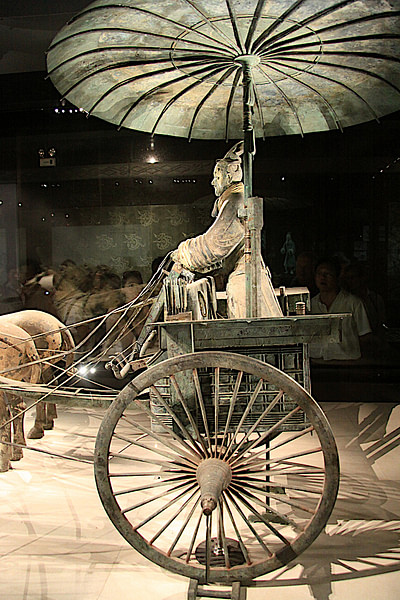
Chinese Qin Chariot
The most famous instance of this is the tomb of Duke Jing of Qi (r. 547-490 BCE), institute in Shandong Province in 1964 CE which, though still not fully excavated presently, is idea to contain the remains of 600 horses sacrificed to accompany the Duke into the afterlife. All of united states drew on the Zhou knowledge of horsemanship and Ying Zheng, in fact, made full use of the chariot and cavalry units adult by the Zhou in subduing the other states.
The Zhou separation of an regular army into units, deployed in different directions in battle, was as well maintained by the Qin every bit was Zhou metallurgy. Shi Huangdi made the well-nigh of Zhou techniques in metalworking by forcing the subdued states to turn over their weapons which were melted down and turned into statues celebrating his reign.
The Zhou contributions which were discarded by the Qin were all in the areas of art and civilization. The Spring and Autumn Period and its time of the Hundred Schools of Thought had produced some of the almost significant philosophical thinkers in the world. The major schools of thought were founded by Confucius (l. 551-479 BCE) whose famous Confucian precepts continue to inform Chinese civilisation, Lao-Tzu (l. c. 500 BCE) who codified and founded formal Taoism, and Han Feizi (fifty. c. 280-233 BCE), founder of the schoolhouse of Legalism.
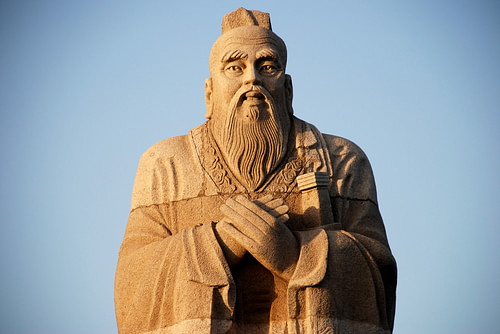
Confucius
There were besides many lesser known, but still pregnant, philosophers such as the sophist Teng Shih (l. c. 500 BCE), the hedonist Yang Zhu (fifty. 440-360 BCE), and the politician and philosopher Yan Ying (l. 578-500 BCE). Among the best-known later philosophers was the famous Mencius (also given every bit Mang-Tze, 50. 372-289 BCE) who would formulate the works of Confucius, and Xun Kuang (l. c. 310 - c. 235 BCE) whose work, Xunzi, reimagined Confucian ideals with a more pessimistic, pragmatic vision. Except for the legalism of Han Feizi, which the Qin adopted every bit its national policy, the work of all these philosophers was ordered destroyed; any which survived had been hidden past priests and intellectuals at the risk of their lives.
Zhou musical contributions were besides undervalued by the Qin, though they were later recognized fully by the Han Dynasty. Central to the values of the Zhou Dynasty were the concepts of Li (ritual) and Yue (music and dance), commonly given as Li-Yue. Music was considered transformative, as explained by the scholar Johanna Liu:
Since the Zhou Dynasty, music has been considered as one important subject in the curriculum including four disciplines for cultivating the sons of regal family and eminent people from the Country to exist prominent future leaders. In the Book of Rites, information technology was said…'the management of Music gave all honor to its four subjects of teaching, and arranged the lessons in them, following closely the poems, histories, ceremonies, and music of the former kings, in order to complete its scholars.' (Shen, 65)
Each piece of music had a corresponding dance and the combination of these was thought to non only improve the moral character of the private but assist in balancing the nature of the cosmos. Confucius believed music to be essential in cultivating a good character, especially in a ruler, and that a lover of music would deport himself, and his administration, justly.
The Book of Rites referenced by Liu is i of the classic Chinese texts which was produced during the Zhou Dynasty during the period of the Hundred Schools of thought. The Four Books and Five Classics – which managed to survive the book burning of the Qin – became the standard texts for Chinese didactics. They are:
- The Book of Rites (also known equally The Volume of Bang-up Learning)
- The Doctrine of the Mean
- The Analects of Confucius
- The Works of Mencius
- The I-Ching
- The Classics of Poetry
- The Classics of Rites
- The Classics of History
- The Leap and Autumn Annals
These works continue to be studied in the present mean solar day and for the same reason: they are thought to not merely educate an individual but also elevate the soul and improve one's overall graphic symbol.
Conclusion
These works were only made possible by the Zhou evolution of writing. The Zhou developed the Shang script Jiaguwen into the Dashuan, Xiaozhuan, and Lishu scripts which would lend themselves to the development of still others. The Zhou's elevation of ancestor worship encouraged the development of religious thought and their vision of the Mandate of Heaven would continue to inform Chinese dynasties going forwards for thousands of years.
If the Zhou had only produced philosophers such every bit Confucius and the others, it would be impressive enough, but they did far more. In the Western Zhou period, they established a decentralized, but cohesive, state which honored and inspired the people of all social classes, not just the noble and wealthy. They consistently improved upon what they had inherited from the Shang and looked for other ways to make their lives, and others', better.
In the Eastern Zhou period, even amidst the chaos of constant warfare, they continued to develop art, music, literature, and philosophy of the highest quality. The Zhou Dynasty's reign of nearly 800 years, in fact, was so profoundly influential at every level of culture that even the destructive policies of the Qin could not erase it. Afterwards the Qin roughshod to the Han Dynasty, the cultural contributions of the Zhou were revived and, today, are duplicate from Chinese civilization.
This article has been reviewed for accuracy, reliability and adherence to academic standards prior to publication.
Source: https://www.worldhistory.org/Zhou_Dynasty/
0 Response to "The Rule of the Zhou Family Was Characterized by"
Postar um comentário