Workshop of Goya Queen Maria Luisa in a Black Mantilla National Gallery of Art
Exhibition dates: seventh October 2015 – 10th Jan 2016
Sainsbury Fly
Curator: Dr Xavier Bray

Francisco de Goya(Castilian, 1746-1828)
The Duke of Wellington
1812-xiv
Oil on mahogany
64.iii x 52.4cm
© The National Gallery, London
Rushing through a dimly lit gallery I recall stumbling upon my first, larger than life, full length Goya portrait in the Louvre, a portrait of a women in a pale bluish clothes. It literally stopped me in my tracks, the visceral affect was so powerful. At that place was a certain tactility to the painting, a presence to the figure that produced this emotive response. And the lite that emanated from the painting. I recollect my jaw dropped to the floor.
Goya can be cutting when he wants to exist, as in the pompous portrait of the buffoonFerdinand VII in Courtroom Dress(1814-5, below); he can exist precise and reserved as inDon Valentín Bellvís de Moncada y Pizarro(around 1795, below) where the optics are the key to the portrait; he can be potent and forthright as in the muscular portrait ofMartín Zapater(1797, below); or he tin be inscrutably honestSelf Portrait before an Easel(1792-5, beneath) and loving Mariano Goya y Goicoechea (the artist'southward grandson) (1827, below). Only to a higher place all, he is man.
The richness and combination of colours, the sense of space that surrounds the sitter (with their mainly contextless backgrounds and the isolation of the figure in pictorial space), their power – both personal and political – and the certain wariness, weariness and insouciance of their expressions… are just a curiosity to behold. It'south as though the sitters had just stopped for a moment to ponder their lives. Nigh equally though they had conjured or envisaged their own visage, every bit if from a dream.
Dr Marcus Bunyan
.
Many thankx to the National Gallery, London for allowing me to publish the photographs in the posting. Please click on the photographs for a larger version of the paradigm.

Francisco de Goya(Spanish, 1746-1828)
The Count of Altamira
1787
Oil on sheet
177 x 108cm
Colección Banco de España
© Colección Banco de España

Francisco de Goya(Castilian, 1746-1828)
The Countess of Altamira and Her Daughter, María Agustina
1787-viii
Oil on canvass
195 x 115cm
Lent by The Metropolitan Museum of Art, Robert Lehman Collection, 1975
© The Metropolitan Museum of Fine art, New York
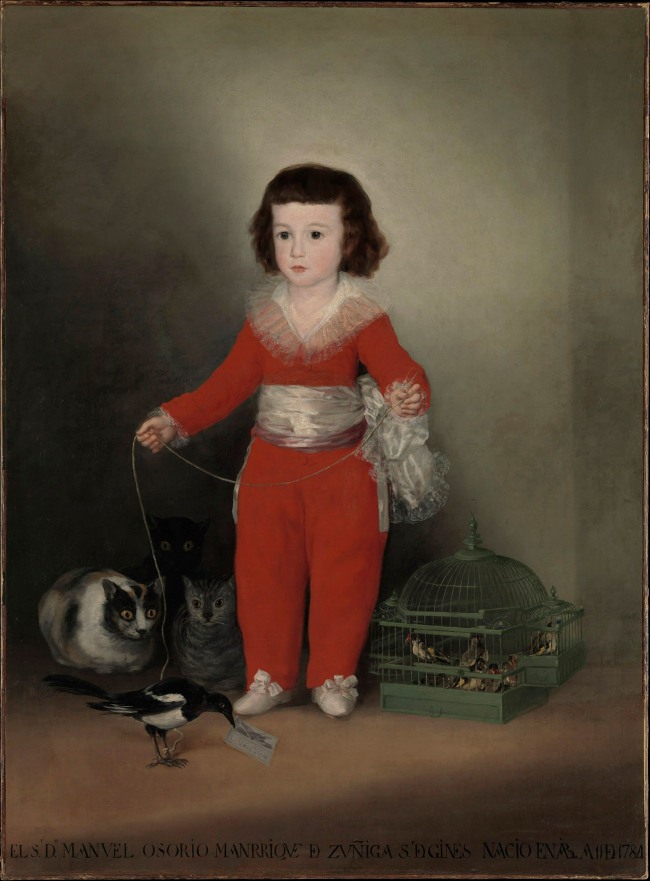
Francisco de Goya(Spanish, 1746-1828)
Manuel Osorio Manrique de Zuñiga
1788
Oil on canvass
127 ten 101.6cm
Lent by The Metropolitan Museum of Art, The Jules Bache Drove, 1949
© The Metropolitan Museum of Art, New York

Francisco de Goya(Spanish, 1746-1828)
The Countess-Duchess of Benavente
1785
Oil on canvas
105 × 78cm
Private Collection, Espana
© Joaquín Cortés

Francisco de Goya(Spanish, 1746-1828)
The Duke of Osuna
1797-1799
Oil on canvas
113 x 83.2cm
The Frick Collection, New York, Purchase, 1943
© The Frick Drove

Francisco de Goya(Spanish, 1746-1828)
Portrait of the Count of Floridablanca
1783
Oil on sail
262cm (103.ane in). Width: 166cm (65.4 in).
Colección del Banco de España, Madrid

Francisco de Goya(Spanish, 1746-1828)
The Duke and Duchess of Osuna and their Children
1788
Oil on sheet
225 10 174cm
Museo Nacional del Prado, Madrid
© Madrid, Museo Nacional del Prado

Francisco de Goya(Castilian, 1746-1828)
The Marquis of Villafranca and Duke of Alba
1795
Oil on canvass
195 x 126cm
Museo Nacional del Prado, Madrid
© Madrid, Museo Nacional del Prado

Francisco de Goya(Spanish, 1746-1828)
The Duchess of Alba
1797
Oil on canvas
210.i × 149.2cm
On loan from The Hispanic Society of America, New York, NY
© Courtesy of The Hispanic Society of America, New York
Francisco de Goya y Lucientes (1746-1828) is ane of Spain's well-nigh celebrated artists. He was an incisive social commentator, considered (even during his own lifetime) as a supremely gifted painter who took the genre of portraiture to new heights. Goya saw beyond the appearances of those who sat earlier him, subtly revealing their character and psychology within his portraits.
Built-in before Mozart and Casanova, and surviving Napoleon, Goya's life spanned more than 80 years during which he witnessed a serial of dramatic events that inverse the course of European history. Goya: The Portraits will trace the artist'southward career, from his early on ancestry at the court in Madrid to his appointment as First Court Painter to Charles Four, and equally favourite portraitist of the Spanish aristocracy. Information technology will explore the difficult menstruum under Joseph Bonaparte'south rule and the accession to the throne of Ferdinand VII, before terminal with his terminal years of self-imposed exile in France. Exhibition curator Dr Xavier Bray says:
"The aim of this exhibition is to reappraise Goya'south status as one of the greatest portrait painters in art history. His innovative and anarchistic approach took the art of portraiture to new heights through his ability to reveal the inner life of his sitters, even in his grandest and near memorable formal portraits."
This landmark exhibition will bring to Trafalgar Foursquare more than 60 of Goya'due south almost outstanding portraits from both public and private collections around the world. These include works that are rarely lent, and some which have never been exhibited publicly before, having remained in possession of the descendants of the sitters. The exhibition volition show the variety of media Goya used for his portraits; from life-size paintings on canvas, to the miniatures on copper and his fine black and red chalk drawings. Organised chronologically and thematically, we will for the first fourth dimension be able to engage with Goya'southward technical, stylistic, and psychological development as a portraitist.
From São Paulo to New York, and United mexican states to Stockholm, individual and institutional lenders have been outstandingly generous, including 10 infrequent loans from the Museo del Prado, Madrid. I of the stars of the prove will undoubtedly be the iconic Duchess of Alba (The Hispanic Gild of America Museum & Library) which has only once left the Usa and has never travelled to Britain. Painted in 1797, this portrait of Goya's close friend and patron shows the Duchess dressed equally a 'maja', in a black costume and 'mantilla' pointing imperiously at the basis where the words 'Solo Goya' ('Only Goya') are inscribed.
Other patrons who assisted Goya on his upward trajectory to become Kickoff Court Painter, equally Velázquez had done more than than 150 years before him, are well represented: these include The Count of Floridablanca (Banco de España, Madrid) and The Duke and Duchess of Osuna and their Children (Museo Nacional del Prado, Madrid) – both fundamental and influential patrons. The immense group portrait of The Family unit of the Infante Don Luis de Borbón (Magnani-Rocca Foundation, Parma), will be reunited with some of the other portraits Goya painted of the Infante'south young family who were living in exile from the Castilian court.
Other highlights volition include the charismatic portrait of Don Valentin Bellvís de Moncada y Pizarro (Fondo Cultural Villar Mir, Madrid) which is unpublished and has never been seen before in public, and the rarely exhibited Countess-Duchess Benavente (Private Collection, Spain). The recently conserved 1798 portrait of Government official Francisco de Saavedra (Courtauld Gallery, London) will be exhibited for the first time in more than than l years alongside its pendant painted in the aforementioned year, showing his friend and colleague Gaspar Melchor de Jovellanos (Museo del Prado, Madrid).
The Countess of Altamira and her girl, María Agustina, which has never been lent internationally from the Lehman Collection at the Metropolitan Museum of Fine art, New York, will come to Europe for the very commencement time to be reunited with her husband The Count of Altamira (Banco de España, Madrid) and their son Manuel Osorio Manrique de Zuñiga (The Metropolitan Museum of Fine art, New York), wearing a fashionably expensive red costume and playing with a pet magpie (which holds the painter's calling card in its nib). Information technology was shortly after completing his imposing portrait of the Countess, wearing a shimmering embroidered silk gown and shown with an introspective expression, that Goya was appointed court painter to Charles IV, King of Kingdom of spain.
Information technology was in his royal portraits in particular that Goya managed to combine his insightful observation and technical refinement to create unique, memorable portraits; in these he condensed the various aspects of his sitter'southward personality into a subtle look or gesture, which ofttimes did not flatter his sitters. Charles 3 in Hunting Apparel (Duquesa del Arco) stands in a pose directly inspired by Velázquez'due south hunting portraits of the Castilian royal family in the previous century, merely the candid portrayal of a weather-browbeaten face with its marked wrinkles and a somewhat ironic gesture is unique to Goya, clearly revealing to us the personality of the King – an enlightened man, a lover of nature and his people, who wished to be approached as 'Charles earlier King'. Similarly, in the portrait of Ferdinand Seven (Museo del Prado, Madrid) nosotros can imagine Goya's mistrust of the pompous and selfish monarch who abolished the constitution and reintroduced the Spanish Inquisition.
In dissimilarity to the formality of his royal portraits, the exhibition also features more personal works by Goya, including a number of self-portraits in dissimilar media, and depictions of his friends and family unit. 47 years lie between the get-go Self Portrait (well-nigh 1773, Museo Goya, Colección Ibercaja, Zaragoza) in the show, completed when Goya was in his late 20s, and the last, the poignant Self Portrait with Doctor Arrieta (1820, The Minneapolis Institute of Art) painted later on an illness from which he most died when he was 74 years old. At that place volition also be a chance to 'meet' the people who were closest to Goya; his married woman Josefa Bayeu (Abelló Collection, Madrid), his son Javier Goya (Courtesy of The Metropolitan Museum of Fine art, Individual Collection; Museo de Bellas Artes, Zaragoza) and his best friend and life-long correspondent Martin Zapater (Bilboko Art Eder Museoa / Museo de Bellas Artes de Bilbao). The exhibition also includes the last work Goya ever painted, of his merely, dear grandson Mariano Goya (Meadows Museum, SMU, Dallas) – painted just months earlier Goya'southward death on 16 April, 1828, this portrait is a attestation to the genius, skill, and unfaltering inventiveness of an artist who persevered with his craft to his very last days.
Printing release from the National Gallery website


Installation photographs of the exhibitionGoya: The Portraits at the National Gallery, London

Francisco de Goya(Spanish, 1746-1828)
The Marchioness of Santa Cruz
1805
Oil on canvas
124.7 × 207.7cm
Museo Nacional del Prado, Madrid
© Madrid, Museo Nacional del Prado
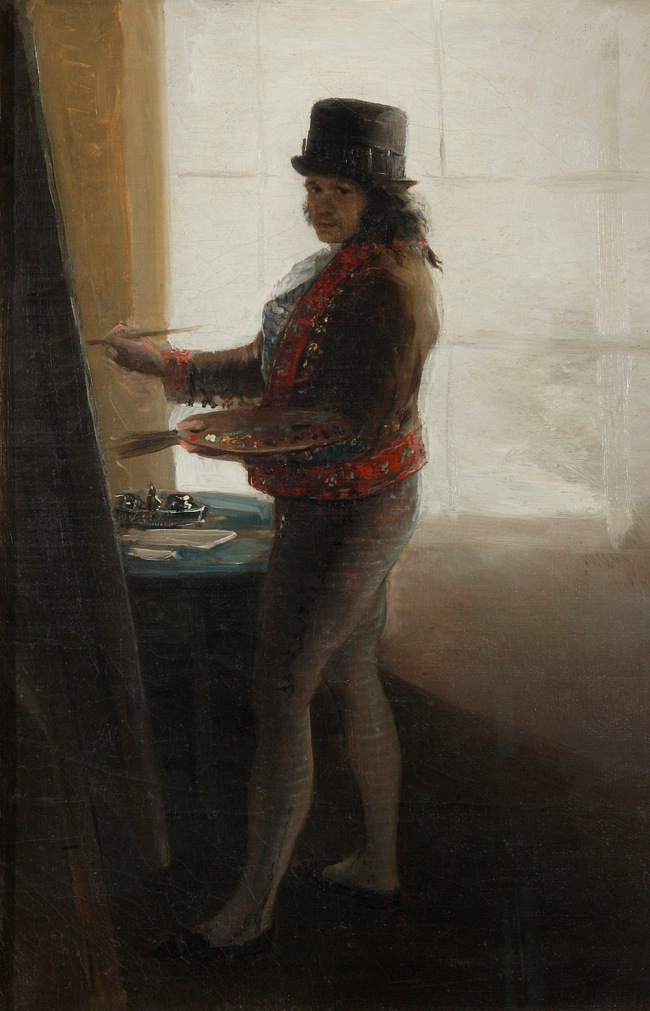
Francisco de Goya(Spanish, 1746-1828)
Cocky Portrait earlier an Easel
1792-5
Oil on sail
42 x 28cm
Museo de la Real Academia de Bellas Artes de San Fernando, Madrid
© Museo de la Real Academia de Bellas Artes de San Fernando, Madrid

Francisco de Goya(Spanish, 1746-1828)
Cocky Portrait
1795-1797
Brush and greyness launder on laid paper
15.3 ten 9.1cm
Lent past The Metropolitan Museum of Art, Harris Brisbane Dick Fund, 1935
© The Metropolitan Museum of Art, New York
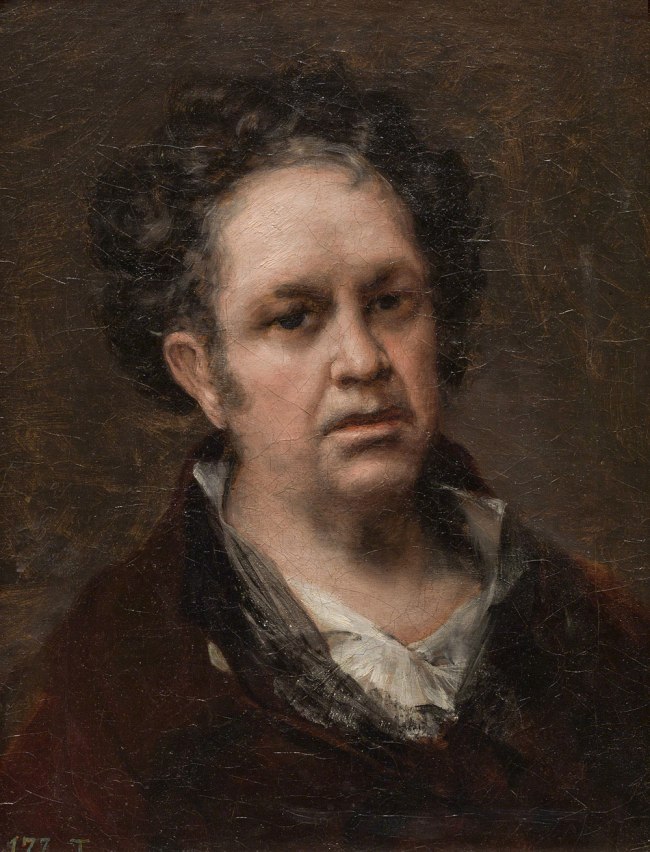
Francisco de Goya(Spanish, 1746-1828)
Self Portrait
1815
Oil on canvass
45.eight × 35.6cm
Museo Nacional del Prado, Madrid
© Madrid, Museo Nacional del Prado

Francisco de Goya(Spanish, 1746-1828)
Cocky Portrait with Physician Arrieta
1820
Oil on canvas
114.vi × 76.5cm
Lent by The Minneapolis Establish of Art, The Ethel Morrison Van Derlip Fund
© Minneapolis Institute of Art

Francisco de Goya(Spanish, 1746-1828)
Gaspar Melchor de Jovellanos
1798
Oil on canvas
205 x 133cm
Museo Nacional del Prado, Madrid
© Madrid, Museo Nacional del Prado

Francisco de Goya(Castilian, 1746-1828)
Portrait of Don Francisco de Saavedra
1798
The Samuel Courtauld Trust, The Courtauld Gallery, London
The Castilian politician Francisco de Saavedra was noted for his integrity. In tardily 1798 Saavedra and his keen friend and ally, Gaspar de Jovellanos, were appointed to the ii highest political offices in Spain: Minister of Finance and Minister of State. Jovellanos was one of Goya'south nearly consistent supporters, and the two men commissioned a pair of portraits from him.
The 2 pictures are closely related. In each, the sitter faces to the correct, and sits on a round-backed chair beside a tabular array. But while Jovellanos is thoughtful, Saavedra seems about to leave his paper-strewn desk having decided on a class of action. The simplicity of the background may be influenced by Goya's knowledge of eighteenth-century English portraiture. It could, all the same, have been called by Saavedra, who was known for the well ordered and 'English' graphic symbol of his household.

Francisco de Goya(Castilian, 1746-1828)
Charles IV in Hunting Wearing apparel
1799
Oil on canvass
205 x 129cm
Colecciones Reales, Patrimonio Nacional, Palacio Existent de Madrid
© Patrimonio Nacional

Francisco de Goya(Spanish, 1746-1828)
María Luisa wearing a Mantilla
1799
Oil on canvas
205 10 130cm
Colecciones Reales, Patrimonio Nacional, Palacio Real de Madrid
© Patrimonio Nacional

Francisco de Goya(Spanish, 1746-1828)
Mariano Goya y Goicoechea (the creative person's grandson)
1827
Oil on canvas
52.i x 41.3cm
Meadows Museum, SMU, Dallas. Museum Buy with Funds Donated by the Meadows Foundation and a Gift from Mrs Eugene McDermott, in honour of the Meadows Museum's 50th Anniversary
© Photograph by Michael Bodycomb

Francisco de Goya(Spanish, 1746-1828)
Doña Isabel de Porcel
earlier 1805
Oil on canvas
82 x 54.6cm
The National Gallery, London, bought, 1896
© The National Gallery, London
The exhibition Goya: The Portraits includes around 70 works unquestionably by his hand, provides u.s. with a unique opportunity to look more closely at Portrait of Doña Isabel de Porcel and enquire the question: is she actually by Goya? This Room 1 display will present historical data surrounding the portrait and its acquisition by the National Gallery in 1896, together with technical show, including an X-ray epitome which reveals an before portrait painted underneath.
Who was Doña Isabel de Porcel?
The sitter has long been identified as Doña Isabel Lobo de Porcel on account of an inscription on the back of the original canvass. Goya exhibited a portrait of Doña Isabel Lobo de Porcel in Madrid in 1805, and this has traditionally been linked to the National Gallery painting. Isabel married Antonio Porcel (Secretary of Country for Spain'due south American Colonies) in 1802 and the couple had four children. Isabel died in 1842, surviving her married man by ten years. Antonio, who was a political acquaintance of Goya's friend and patron Gaspar Melchor de Jovellanos (whose portrait tin can be seen in Goya: The Portraits), was also painted by Goya in 1806, but his portrait was destroyed by fire in 1953.
The National Gallery's buy of Portrait of Doña Isabel de Porcel
The National Gallery bought Portrait of Doña Isabel de Porcel in June 1896 for but over £404. It was among the outset pictures past the artist – and the very first portrait by Goya – to enter the National Gallery collection, having made its get-go Goya purchases(A Picnic andA Scene from 'The Forcibly Bewitched') the previous month. The portrait was no longer owned by the sitter's descendants when the Gallery acquired information technology, having been sold past the Porcel y Zayas family unit from Granada, in whose possession it had apparently remained until around 1887, to Don Isidro de Urzáiz Garro (d. 1894). It was from the latter'south heir, Andrés de Urzáiz (1866-1912), that the Gallery acquired the portrait about 10 years afterward.
A question of attribution
The glamorous sitter is shown wearing a black lace 'mantilla', a traditional headdress which became stylish among the Spanish aristocracy in the late 18th century. Although painted with tremendous flair, the film's brushwork – when compared with Goya'southward other portraits – lacks his customary subtlety in describing transparencies and textures. Isabel is extremely charismatic only we struggle to grasp her psychological land – something in which Goya invariably excelled.
The hidden portrait
When an X-ray prototype was fabricated of the Portrait of Doña Isabel de Porcel during conservation treatment in 1980, some other portrait was unexpectedly found underneath. The head and striped jacket of the underlying figure are clearly visible in the X-ray, and Doña Isabel de Porcel was painted directly on top of the initial portrait, without first hiding it with new priming. Although perhaps surprising, this is not unique in Goya's work. During the flow of political upheaval in Spain at the turn of the 19th century, Goya – and other artists – had to be resourceful and adapt to circumstance, recycling canvases equally their patrons roughshod in and out of political favour. Doña Isabel de Porcel must have been painted before long afterward the underlying portrait, since no dirt is visible betwixt the paint layers of the two figures. A clearer paradigm of the underlying portrait has recently been obtained by using an 10-ray fluorescence scanning spectrometer, a cut-edge piece of analytical applied science on loan to the National Gallery through collaboration with Delft University of Technology, which maps the chemical elements in the paint.
Letizia Treves, National Gallery Curator of Italian and Spanish Paintings 1600-1800, says:
"Goya is one of the most admired and imitated painters in the history of fine art. Pastiches and forgeries of his works proliferated on the European and American art market place in the 2d half of the 19th and early on 20th centuries. The technical studies and provenance information regarding the Portrait of Doña Isabel de Porcel are inconclusive so far as Goya'southward authorship is concerned, and the attributional status of the painting rests largely on perceptions of quality and on how close it comes to works that are indisputably by the creative person – something nosotros all have a unique opportunity to explore during the exhibition Goya: The Portraits. If information technology is a pastiche, information technology has been carried out with such impressive skill that its long-standing attribution to Goya has convinced several generations of specialists and gallery visitors."

Francisco de Goya(Castilian, 1746-1828)
Martín Zapater
1797
Oil on canvas
83 x 65cm
Bilbao Fine Arts Museum
© Bilboko Arte Ederren Museoa-Museo de Bellas Artes de Bilbao

Francisco de Goya(Spanish, 1746-1828)
Ferdinand VII in Court Apparel
1814-5
Oil on canvas
208 ten 142.5cm
Museo Nacional del Prado. Madrid
© Madrid, Museo Nacional del Prado

Francisco de Goya(Spanish, 1746-1828)
Don Valentín Bellvís de Moncada y Pizarro
around 1795
Oil on canvas
115 x 83cm
Fondo Cultural Villar Mir, Madrid
© Fondo Cultural Villar Mir, Madrid
The National Gallery
Trafalgar Square, London WC2N 5DN
Opening hours:
Daily 10am – 6pm
Friday 10am – 9pm
The National Gallery website
LIKE ART BLART ON FACEBOOK
Back to superlative
Source: https://artblart.com/tag/francisco-de-goya-maria-luisa-wearing-a-mantilla/
0 Response to "Workshop of Goya Queen Maria Luisa in a Black Mantilla National Gallery of Art"
Postar um comentário