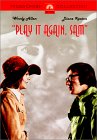
Play It Again Sam 1972 Dvd

 |
Savant Brusque Review:Play it Again, Sam
| ||||
| From standup comic to television author, to playwright to movie star and manager, Woody Allen's career had a solid trajectory through the 1960s. His play Don't Drink the Water was turned into a pretty forgettable film with Jackie Gleason in 1969, but this 2nd film accommodation was every bit as successful every bit the movies Woody directed himself. The part actually was made for Woody, and it brought him together for the first time with the kickoff of his 2 major romantic co-stars, Diane Keaton. Play it Again, Sam restates the basic Woody Allen comic graphic symbol as if nobody had ever seen him before, and equally such may seem a chip dated to 2002 movie fans. At the time Woody had two of his own scrappy merely joke-driven films under his chugalug, and was moving on to the more than promising ground of more developed comedies like Sleeper, and more than complicated movie parody features like Everything You Always Wanted to Know About Sex activity. Play information technology Once again, Sam seems tiresome at the beginning because information technology's almost besides generic, with Allen clowning around minus annihilation particularly cinematic or innovative to keep up the interest. Basically a serial of horror date tales, with Woody striking out in ever more humiliating ways, the show hits its step when Woody interacts with the spirit of Humphrey Bogart, imitated fairly accurately by Jerry Lacy. Bogart'southward exhortations for Allan to grab and osculation women, to prove them who'due south boss, of course backlash miserably. Totally pathetic when using his own persona, Allen equally Allan resorts to a constant menses of slapstick and pratfalls to keep the level of one-act upwards. Some of these are hilarious, like the way Allan mangages to toss tape albums across the room and stumble over his own furnture. An interesting option of actresses play the other women in Allan's life. Susan Anspach equally his estranged wife is practically supportive in her utter rejection, and going back is never an option. Jennifer Salt (Sisters) can't believe her engagement isn't a total nutcase. Warhol actress Viva plays a nymphomaniac, and Joy Bang a thrillseeking daughter who gets carried off by bikers in mid-date. When Woody'southward human relationship with Diane Keaton's character finally develops, the humour becomes more interesting. Unlike the annihilation-for-a-joke schlemiels of Bananas and Accept the Money and Run, Allen's character here has a conscience and a business organisation for others, and points the way to the more adult centre-career Woody that would appear in Annie Hall. In this first film together, there isn't and so much a romantic chemistry between Allen and Keaton every bit in that location is a visibly obvious joy in working together. In one angle on Keaton on a burrow reacting to Allen (while Roberts maintains a bully deadpan), Keaton'due south and then broken upward, she looks like she'south going to pee her pants. The funniest scene is the romantic showdown where Bogart is encouraging Allan to come up on to Linda in his apartment. The three mode banter between the pair and the ghost simply Allan can see and hear, is almost excruciatingly funny, with Allen getting more comedy mileage from his reactions than his verbal delivery. Director Herbert Ross finds good camera positions for most of the gags and pretty much keeps out of the manner; he's less fussy only also less accurate than Woody is when directing his best pictures. The most dated attribute of Play it Again, Sam is the finale that apes the end of Casablanca. It still works well, only after xxx years of hommages and parodies and restagings of famous movies, it's as well easy to forget that the thought was adequately fresh in 1972. Like one of Allen'due south nicely-turned New Yorker stories, the parody, the romance, and Allan's foolish reliance on the Bogart persona are all resolved at in one case, and the film ends on a loftier note. Paramount's DVD of Play it Again, Sam has an okay sixteen:9 transfer that is adequate merely not all that attractive. Owen Roizman'south photography looks a bit deadening and muddied, and it's not clear whether that's a purposeful choice or if this is just not a peppy transfer. There's a French track in addition to the English, and that's nearly it - not even a trailer for an actress. On a scale of Fantabulous, Good, Fair, and Poor, Beloved Glenn: Muddy. PLAY IT Once again, SAM has been muddy ever since Par briefly reissued the movie -- with a terrible trailer and cartoonish central-art -- earlier its network tv airing. Original prints were almost certainly in IB Technicolor; at any rate, the 1972 release prints featured a generally subtle use of beiges, tans, roses and browns -- there were a few grainy scenes, but the pic looked good. Intentionally soft, non stagnant. Better looking than Woody's movies to that time, anyhow. It'south almost blasphemous to say this these days, merely I think he learned a lot from Herbert Ross -- the four principals knew the work very well, only Ross sort of restaged or, better, choreographed the thing for the screen. Non in a formal way -- the road trip and SF location stuff are fun and softball diversion -- but when the principals are together, everything is covered, timed and enacted in a sort of deeply satisfying mode. Players in position. Trapeze artists set up. Cue the orchestra. Well fabricated bear witness. I think telling a film Prof. in May of '72 -- "It's Allen'southward Dark AT THE OPERA!" He was disappointed. He thought information technology too sentimental and romantic; he missed the farce and inspired silliness and satire of BANANAS. I think BANANAS is tops -- there'south no moment in movies to compare, say, with J. Edgar Hoover's advent at Mellish's trial. Simply I was moved past SAM. Already I'd seen far, far too many movies. And your observation about the rapport betwixt Allen and Keaton is absolutely correct. [I'll spell it out, okay? The movie-loving nebbish gets the girl. All right?] Interestingly, though SAM was an effort by Par, Arthur P. Jacobs and Allen & his people to make a comparatively mainstream moving picture to capitalize on his growing fame and popularity, its initial response was disappointing. Information technology previewed very well, and Par opened it pretty broad in big theatres in May 1972; it even played Radio City Music Hall. But the picture did ho-hum business organisation. Par and Jacobs refused to give up on the film, though. Later a few weeks, the movie was rebooked into sectional commencement-run houses and specialty houses -- NY'due south Cinema one, Detroit's Studio viii and similar theatres around the country -- biz was solid, and the flick has had a solid, if visually dingy, life ever since. Best, E'er. -- B |
Source: https://www.dvdtalk.com/dvdsavant/s388play.html
0 Response to "Play It Again Sam 1972 Dvd"
Postar um comentário